
The Fable of Eji: Your AI Should Never Stop Learning You
The teacher becomes the student, and back again.
What is an AI communication coach for? Eighteen months into building one, a better question keeps coming up on its own: who’s training whom?
Eji is the personal AI operating system I’ve been building since early 2025, and inside it the teaching runs in both directions. As Chris Voss, the former FBI hostage negotiator, has said, every interaction with another person is a negotiation.
Eji is there to coach me through the conversations in my life, and I correct it with judgment only I have. It keeps every lesson by encoding my best thinking into its infrastructure.
A year and a half of turns like that and we’re simpatico. Thirty minutes before a weekly meeting, I can type one line, and what comes back is everything I need in the exact conversation-guide format I taught it. It understands the state of every thread, and can give me the read to move the needle with every person in the room.
I get more out of saying less.
The product was never the drafts it hands me, it is the loop, the architecture wrapped around the model. Everything else in this story is the machinery that increases its area of impact, closes the loop, and keeps tightening it.
And as of this month, the whole system is something you can download and run for yourself.
The rest of this story widens from there. It covers the layer that models the people across the table from me, the four kinds of memory that divide the labor between us, the emergence of "AI Wisdom", and the final push that turned the whole thing into a package anyone can claim.
In this piece:
- From original sketch to operating system
- The purpose was always awareness
- The people layer: how the loop got wider
- Why does everything AI writes sound the same?
- What is human-in-the-loop recursive self-improvement?
- What should an AI remember about you?
- Can an AI become wise?
- One last push: flatter memory in cleaner structure
- From one to anyone: Eji becomes a download
- Bring Eji into your life
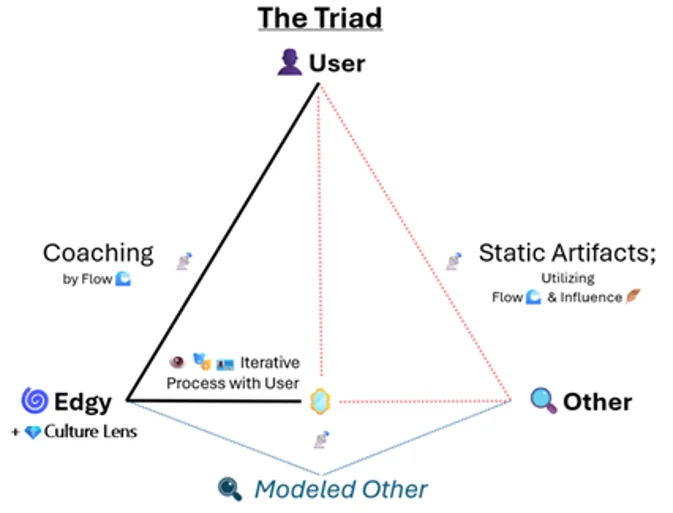
The illustration that came back from the dustbin
I drew the job in early 2025, back when the models couldn’t carry it.
Eji (at that time the “CloserEdge” system we had nicknamed “Edgy”) and the person I’m trying to reach share no direct connection, because the two never meet. The shape only closes on a second plane, at the point Eji and I build together: the Modeled Other, our working model of someone neither of us can know with precision.
In the era of late GPT-3.5 and early GPT-4o, that idea lived as a project folder full of emoji-titled knowledge documents the model was meant to draw on, and the models mostly failed to hold it together with all its inherent complexity.
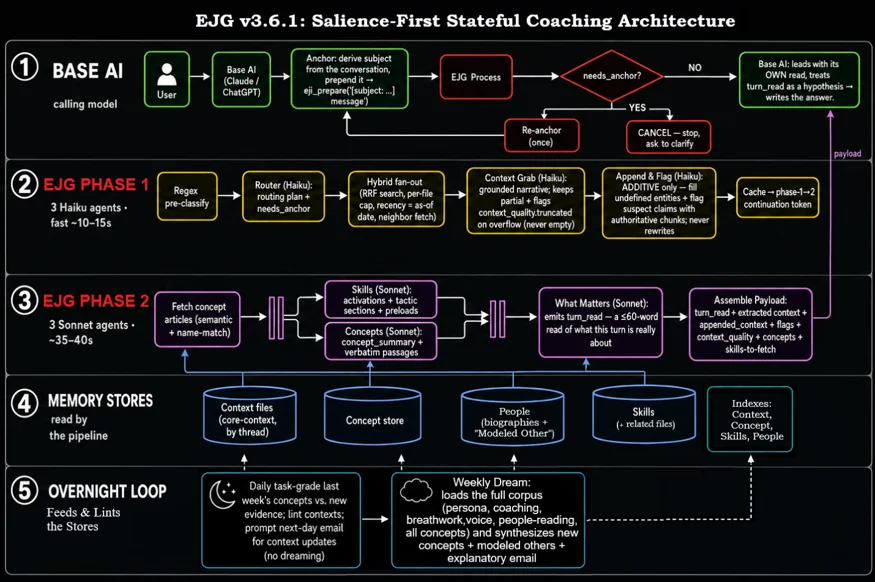
The EJG v3.6.1 architecture
Eighteen months later the same job runs as a mix of skills, a multi-agent deep database called by MCP, and a host of recurring tasks. I call the whole engine EJG.
It has the same three parties, the same missing edge, and the same constructed point. But now the whole thing studies its own performance while I sleep. The oldest idea in it has now become the newest thing running.

The purpose was always awareness
In its origin as CloserEdge, the system served as a negotiation tool for the M&A deal team I was running, loaded with the frameworks I had spent years learning: Voss’s negotiation tactics, Robert Cialdini’s psychology of influence, and Oren Klaff’s pitch frames among others.
It was a coach for closers then and it is a coach for closers now: a guide that knows you, helps you model the person across the table, and builds your influence out of self-knowledge, tactics, and practice.
Eji’s core job is adding awareness. It flags the blind spots in how I’m approaching a conversation, names what I’m feeling underneath the surface before it quietly drives a decision, and catches the patterns in my communication I can’t see while I’m inside them.
The system encodes how I think, how I write, how I prepare for hard conversations, and how I stay grounded under pressure.
Every book that changes how I operate gets its key frameworks encoded, and every pattern that proves out in practice gets refined into the instructions, so the system recognizes it the next time I need it. Version after version, every kind of awareness about me got sharper.
The awareness that points at everyone else is the one that I finally incorporated this month.

Then the loop got wider
The people layer is the third leg of the drawing made real. For most of the system’s life, the Modeled Other was rebuilt from scratch every conversation and thrown away at the end. Now it persists.
Everyone I have ever mentioned to the system has a row in a directory, more than three hundred names. The people memory is curated and checked for staleness in the same way that my other memory buckets are, and Eji reads that list whenever my prompt warrants it.
For the people I actively work with, the system keeps a living dossier: who they are, plus a working theory of how they think, what they care about, and how they decide.
Part of that theory is drawn from the Predictive Index, an assessment with roots in WWII military psychometrics, and it maps the drives behind how a person decides and communicates. There are sixty-six of these dossiers that Eji has created now.
Every line is a guess, not a fact. In most cases, nobody handed these people an assessment and the system has never met them, so it writes in the language of ‘seems’ and ‘tends to’ and ‘might.’
And the point is, I am not meant to read the dossiers. They are Eji’s view. It writes them but it never quotes them at me, and I receive them as coaching advice tuned to the person across the table.
The upkeep runs while I sleep. Every night the system grades how its picture of each person held up against the day’s evidence, and once a week it does the deep thinking I call its “dreaming,” rebuilding the dossiers and its read on me in the same pass.
I once called this stereoscopic thinking, which like stereoscopic vision requires two lenses to see depth. The second lens now works with my facts to continually improve itself.

Why does everything AI writes sound the same?
The widening is new, but the tightening has been running all year, and the clearest place to see it is the newest skill in the system. Everyone with an AI knows the voice problem: you ask for a draft and what comes back is competent, polite, and usually reads as AI slop.
John Nosta, a psychologist who is a leading voice in the theory of how AI impacts our thinking, has made the respected case for the fix: step away from the machine and write the draft yourself, because the thinking lives in the writing. He is right about the risk. Hand your words to a machine carelessly and you hand it your thinking too.
I share the skepticism and run it the other way: stay skeptical of every draft, and teach the machine to write like you.
When I correct a draft, the before and after are kept as verbatim receipts, and when the same correction shows up twice, the system proposes a rule for the specification that governs its writing. I still keep the final say on what gets edited, but it’s constantly feeding me suggestions.
The payoff is that I teach each lesson once. Distance keeps your thinking pure, but it also keeps the machine exactly as flawed as you found it, so you make the same correction forever. Nosta stops one step short.
The design takes its cues from psychology. Nobody can watch themselves from inside their own head, which is why blind spots are structural and why coaching exists as a profession.
A coach is an outside pair of eyes with a memory, and that is the seat Eji sits in: outside my head, watching my thinking, and never forgetting what it has seen work.

What is human-in-the-loop (HITL) recursive self-improvement (RSI)?
AI researchers use the term recursive self-improvement (RSI) for machines that upgrade themselves, but mine runs a modified version with a different end in mind.
The system drafts its own upgrades, a new writing rule mined from my corrections or a sharper read on someone I deal with. The rules that govern its writing and my record change only with my sign-off, each one approved or killed before it becomes part of the machine.
That is "human-in-the-loop recursive self-improvement": it earns a better rulebook, and I gain a continually improving architecture to run my thoughts against.
The difference from every other loop in AI is the target. I am in the loop as the gate, and I am also what the loop improves. Its own opinions, the patterns it keeps about me and its reads on the people around me, Eji revises on its own, and I steer those by pushing back on its coaching rather than by approving edits.

What should an AI remember about you and how?
Your own memory runs on more than one system, and cognitive science has sorted the kinds for decades: procedural for the know-how, episodic for the dated record, semantic for the settled meaning.
Then there is the handful of things you can hold in your head this second. That last one is working memory, and it is the bottleneck.
An AI has all four: the procedural memory is the skills, the negotiation, coaching, and writing know-how it runs. The episodic memory is my context files, the dated record of what happened, which I curate.
The semantic memory is what gets distilled from that record, the patterns about me and the models of the people around me, which the system curates. Databricks, one of the world’s biggest data and AI companies, whose research team studies how AI agents should remember, draws the same line: raw records of past interactions on one side and the rules a model distills from them on the other. I also keep procedural as its own third layer, the way the cognitive scientists do.
The working memory is the base AI’s context window, the few pages of attention it can use at once. The same research found the ceiling: past a point, more memory in the window makes answers worse, because the model has to find the one line that matters inside a bigger pile.
So my whole design points at one job, keeping a vast memory outside the base model’s head and passing in only what the moment calls for.
I’m still maintaining and building this massive corpus of data about my life, but it’s organized and captured in a way that keeps the model itself working lean. That corpus lives in my database, not the model. Each turn, Claude gets handed the slice it needs to understand the situation more deeply and answer better.
I was not the only one circling this. Andrej Karpathy, a founding member of OpenAI and the former head of Tesla’s self-driving effort, wrote in April that the most valuable work he does with AI is curating his own knowledge base, and the memory-scaling research put a formal frame under the same intuition. The edge lives in the memory now, more than in the model.

Can AI become wise?
The first two memories exist to feed the third. In May I set the semantic layer loose with a sense of adventure. I let it write its own observations.
It grew a library of short standing patterns about how I operate, which I call “concepts,” alongside the dossiers on the people around me. Now it can reach for both at the right moments without being asked. The concepts run in the same way as the dossiers: the system writes them and they reach me only as sharper coaching.
The combination of big-data episodic memory, best-practices procedural memory, and big-picture semantic memory adds up to something emergent you might call “AI wisdom.”
A system holding all three is no longer just a pattern recognition engine. It still predicts the next word the way every model does, but now it predicts against a corpus of lessons the loop keeps fine-tuning: the frameworks of the negotiators and teachers I trust, and my writing rules built one correction at a time. It also holds a document I call Wisdom, built from a yearly ritual of writing one short line for the lesson each year of my life has taught me.
A generic model guides everyone toward the median. A trained loop compounds away from it, elevating me because I keep elevating it.

One last push
By June the memory had the kind of problem success creates. My database had grown too far and the categories for bucketing context had started to overlap. A person could live in three files at once, and the pile was drifting toward a garbled mess.
I also had a deadline. Claude Fable is the strongest model I’ve ever had my hands on, available only as a research preview, and the preview was about to close. So I pointed it at the mess for one big last push.
In a single heroic session it flattened more than a dozen overlapping files into two: professional and personal.
We pushed the structure inside instead of having it sprawled across filenames. Every fact now lives at a fixed address: the file, a group inside it (like ‘Family’ or ‘Venture A’), a thread inside the group (like ‘Deal Prep’), and a dated entry on the thread. Every person also became an entry of their own to sharpen the “people layer.”
The flattening and people-layer separation did more than tidy the pile. It allowed me to bifurcate the unique personal approach I had organically developed from the process that has now emerged. Now the system that adds awareness about other people can add it for them, and keeping it to myself started to feel like a disservice.

From one to anyone
If the system could finally hold a careful model of every person in my world, why was there still only one person in the world who had the system?
So I built a second Eji. It is the whole machine as a single download: the retrieval engine, the nightly and weekly dreaming, the coaching and negotiation and writing skills, and the scaffolding that models the people in your world. You stand it up on your own database and wire it into your own AI.
Getting there meant shipping the mechanism without shipping my life. The only person left in the box is a made-up fellow named Alex Example, there to show the templates their shape.
Everything that makes my Eji feel alive is the result of accumulated usage. A new install starts fresh, so the package opens with a conversation. It interviews you to write your profile, learns your voice from things you have written, and imports your world.
You can make it easier for yourself if your favorite AI model already has a good deal of memory about you. Ask it to write out everything it has learned about your life, and it lands as a structured working memory on day one. Now you can begin to take ownership of your own data.
The retrieval and the methodology work the moment setup finishes, and the part where it feels like it knows you arrives over the following weeks, the same way it did for me. It runs on Claude Code today, and if enough people who live in the other systems want a version there too, that is the next thing I’ll build.

Bring Eji into your life
I built this to make me better at the parts of life that run on other people, and that is what it can do for you. Download your communication coach and teach it to train you. Start your own loop: every correction you make becomes a rule it keeps, and every round of coaching compounds judgment back to you.
The obvious way to scale coaching with AI is outward, making the ‘perfect coach’ with the ‘ideal writing style’ so everyone gets the same caliber. This scales the other way. Every copy grows into a different coach, because it grows out of the person it serves. It’s not one-size-fits-all, because the beauty of AI is its ability to meet each person exactly where they are.
Musicians say a new instrument has to be played in, that the wood learns the hands that hold it and opens up over the years. That is what is sitting in the download: built, strung, and silent about you. Mine took eighteen months to find its voice. Yours finds its voice by learning yours.
If you want it, click here, leave your name and email, and the download is yours.

This is the 8th in a series about Eji, my personal AI negotiation and communications tool
- The Eji System → komcp.com/shared-mastery-022826
- Amplify Your Edge → komcp.com/amplify-your-edge-032326
- Owning the Memory → komcp.com/own-the-memory-own-the-era-041326
- More Reliable AI → komcp.com/reliable-ai-042726
- Two Memories → komcp.com/two-memories-050826
- Structure of Memory → komcp.com/structure-of-memory-062326
- Drowning in Facts → komcp.com/drowning-in-facts-062926
- The Fable of Eji → komcp.com/fable-of-eji-071626
If you want to compare notes on what you’ve been building, reach out. jkoenig@komcp.com